

THANK YOU FOR SUBSCRIBING

Hrtech Outlook Weekly Brief
Be first to read the latest tech news, Industry Leader's Insights, and CIO interviews of medium and large enterprises exclusively from Hrtech Outlook

 Nate Kenney, CEO
HR professionals looking for support with Unemployment Cost Management (UCM) face familiar pressures, including managing compliance risk, controlling costs, and gaining visibility in a highly regulated, constantly changing environment. For more than three decades, Thomas & Company has served as a trusted partner in the UCM space, helping employers reduce administrative burden while delivering measurable results through a powerful combination of human expertise and technology.
Rooted in a client-first mindset built on precision, trust, and long-term accountability, the company remains focused on enabling success for employers and stakeholders.
As the company expanded beyond UCM, it followed a clear principle: grow only when expansion strengthens client value. This approach shaped Thomas & Company’s evolution into a broader suite of employer services supporting an interconnected ecosystem of employers, employees, government agencies across all 53 jurisdictions, verifier communities, and internal client teams.
By staying close to client needs and building long-term partnerships, Thomas & Company expanded into additional services, including Employment and Wage Verifications (EWV), Work Opportunity Tax Credits (WOTC), and Employer Tax Services (ETS). Together, these solutions help employers of all sizes reduce administrative burden, improve compliance, control costs, and generate ROI without sacrificing the high-touch service the company is known for.
“Our focus is building tangible and sustainable value for all stakeholders,” says Nate Kenney, CEO. “That discipline allows us to expand thoughtfully without losing sight of the people and processes at the center of employer services.”
A Long View Built on Trust
How has Thomas & Company sustained leadership amid consistent regulatory change?
Longevity in the UCM space is rarely accidental, given ongoing regulatory change, advancing technology, market consolidation, and rising employer expectations. Thomas & Company has remained a leader by growing through relationships and listening closely to clients.
 Centered on a strong UCM foundation, Thomas & Company expanded into additional services, with a consistent focus on simplifying complex employment processes for HR, payroll, and tax leaders while protecting compliance and reducing cost exposure. The company blends deep subject-matter expertise with secure, intuitive systems that help employers operate with confidence.
This continuity preserves institutional knowledge developed through decades of real-world complexity, refinement, and long-term partnerships.
“When you stay close to your clients long enough, patterns emerge,” Kenney says. “Those patterns guide better decisions about technology, service models, and where to invest next.”
Value That Moves from the Inside Out
How does an inside-out value model strengthen employer services across interconnected stakeholder ecosystems?
Growth at Thomas & Company follows a disciplined principle: value is built from the inside out. Each decision begins with one question—how will this improve outcomes across the ecosystem?
Employees, verifier communities, and regulatory bodies all shape outcomes, and progress in one area affects the others. Recognizing this interdependence early, Thomas & Company shaped its model around helping, making the ecosystem itself the foundation for service design and delivery.
Technology, quality, and security support that foundation. Technology serves as an enabler—simplifying complexity while remaining grounded in human expertise and judgment. Quality is a daily operating discipline, driven by a service-first culture delivering high-touch support without friction.
Structured feedback programs, including advisory boards, stakeholder interviews, and CSAT measurement, keep innovation aligned with real client needs. This allows Thomas & Company to evolve without losing coherence, giving clients continuity across teams, systems, and strategic direction.
A Unified Employer Services Ecosystem
Thomas & Company has built a comprehensive employer services suite reflecting how organizations operate, not how services appear on paper.
UCM is positioned within a broader employer services network rather than as a standalone offering. Clients receive end-to-end claim management, proactive tax support, and reporting visibility that reduces administrative burden while strengthening outcomes across the employment lifecycle.
To support this approach, Thomas & Company continues investing in technology that simplifies communication and decision-making, including the SHIELD platform, an integrated business hub providing workflow visibility and cross-service communication.
Unlike vendors delivering tools or transactional services, Thomas & Company creates continuity across systems, teams, and stakeholders, ensuring a consistent client experience regardless of business conditions.
Reducing Administrative Burden through Partnership
How does partnership reduce administrative burden for employers across complex organizational structures?
Administrative burden rarely announces itself clearly. Thomas & Company begins engagements with structured working sessions across cross-functional client teams to surface priorities, challenges, and workflows.
Workflow analysis reveals how time is spent, where inefficiencies exist, and what they cost. Opportunity costs are quantified, ROI modeled, and clients gain a clear path to realigning internal bandwidth, supported by technology and expert service delivery that delivers measurable economic value.
Before engagement, administrative responsibility often sits across multiple internal teams, consuming time through manual oversight, compliance checks, and follow-ups. After implementation, workflows consolidate, routine tasks automate, and experts shift toward analysis, guidance, and risk management, creating real human capital reallocation, not theoretical efficiency.
“Trust builds when clients can see the numbers and understand the ‘why’ behind them,” Kenney explains. “That transparency is what allows change to happen without disruption.”
This process is continuous. Teams revisit workflows, assess metrics, and refine delivery over time. Education and training reinforce improvement through targeted learning, dashboards, and proactive thought leadership, helping clients address issues before they escalate.
Thomas & Company’s partnership model reflects how complex organizations truly function, cultivating relationships across HR operations, HRIS, payroll, tax, legal, compliance, risk, and IT security, ensuring every stakeholder has support and visibility to drive outcomes.
Technology That Supports Human Judgement
Tools alone cannot resolve intricate challenges. Thomas & Company’s tech-enabled approach strengthens service delivery while human expertise guides context, judgment, and decision-making. This balance produces tailored solutions and a client experience defined by clarity, consistency, and confidence.
Technology also reduces routine administrative effort, allowing leaders to focus on analysis, strategy, and decision support. Thoughtful automation gives experts more time to help clients navigate complexity and improve outcomes.
Continuous improvement is supported through performance metrics, quality assessments, and ongoing stakeholder feedback, ensuring innovation remains deliberate, measurable, and aligned with client needs.
“This mindset reflects a culture where accountability is expected, feedback is acted on, and every process is challenged to be better than it was yesterday,” adds Kenney.
Quality as a Way of Operating
At Thomas & Company, quality is not a checklist. It is ingrained in daily operations, performance evaluation, and response to feedback. Core values are not wall statements; they actively guide execution and strategy across every role.
Performance metrics receive constant attention, not as static measurements but as signals for action. Quantitative data is paired with stakeholder insight from client feedback loops, creating accountability that drives measurable improvement.
“As relationships deepen over time, clients view Thomas & Company not as a vendor, but as a true partner and extension of their internal teams,” says Kenney.
A Mission That Holds Everything Together
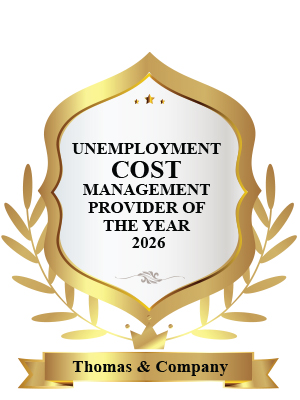
As markets evolve, regulations shift, and competition intensifies, Thomas & Company responds through strategic investment, deliberate modernization, and close attention to stakeholder sentiment. This consistency has earned recognition as Unemployment Cost Management Provider of the Year, reflecting long-term credibility and sustained execution.
The focus remains on strengthening technology, expanding functionality, and anticipating regulatory change without compromising service quality, judgment, or partnership. Thoughtful investment keeps systems scalable and modern while maintaining a consistent, human-driven client experience.
At Thomas & Company, purpose is reflected in execution, not messaging. It appears in daily operations, partnership-building, and sustained accountability, reinforcing that endurance is built through action, not circumstance.
“We’re here to deliver transformative, technology-enabled solutions with a relentless focus on service quality, innovation, and partnership,” adds Kenney.
What led to Thomas & Company being recognized among top unemployment cost management providers?
Thomas & Company earned this recognition through its consistent delivery of measurable results in a highly regulated HR environment. Its ability to combine deep regulatory expertise with technology-driven solutions has positioned it among leading Unemployment Cost Management Providers. The company’s client-first philosophy, along with its focus on innovation and compliance, played a key role in securing the 2026 industry award.
How does Thomas & Company differentiate itself in unemployment cost management?
A defining strength lies in its integration of human expertise with advanced platforms such as SHIELD, which streamlines claims and improves visibility. This balanced approach allows the company to address complex compliance requirements while delivering actionable insights. Within the landscape of Unemployment Cost Management Providers, this combination of technology and personalized service creates a distinct competitive advantage.
How does Thomas & Company help organizations manage compliance and cost challenges?
Managing unemployment-related risks requires precision, and Thomas & Company supports this by simplifying regulatory complexities and improving cost control. Its services help organizations reduce administrative burden while maintaining compliance across evolving jurisdictions. This capability reinforces its role among trusted Unemployment Cost Management Providers that enable organizations to operate confidently in a changing regulatory landscape.
What role does technology play in Thomas & Company’s solutions?
Technology is central to the company’s strategy, particularly through its SHIELD platform, which enhances automation, analytics and process efficiency. By transforming traditionally manual workflows into data-driven operations, the platform enables faster decision-making and improved accuracy. This focus on digital enablement strengthens its position among modern Unemployment Cost Management Providers that prioritize both efficiency and insight.
How does Thomas & Company create long-term value for its customers?
Long-term value is achieved through a combination of cost recovery, risk mitigation and operational efficiency. Thomas & Company helps organizations optimize unemployment claims management while maintaining high standards of service and accountability. Its ability to align services with client needs ensures sustained outcomes, making it a reliable partner among Unemployment Cost Management Providers focused on measurable impact.
Why is Thomas & Company relevant in today’s evolving HR landscape?
As regulatory demands grow more complex, organizations require specialized expertise to manage unemployment costs effectively. Thomas & Company addresses this need by continuously adapting its solutions to meet changing requirements while maintaining a strong emphasis on client success. This forward-looking approach ensures its continued relevance among Unemployment Cost Management Providers supporting modern HR functions.
Company
Thomas & Company
Management
Nate Kenney, CEO
Description
Thomas & Company is a leading provider of value-added employer services and innovative solutions to support employee relations programs. The company is an industry leader in unemployment cost management, employment and wage verifications, and tax credit solutions, serving clients with unmatched expertise and dedication for over 30 years. With a commitment to excellence and innovation, Thomas & Company empowers organizations to navigate complex regulatory environments and achieve their business objectives.

